
1
Monitor biometrics
Explore combined trends in heart rate, HRV, sleep, activity, and optional skin conductance against a personal baseline.
→
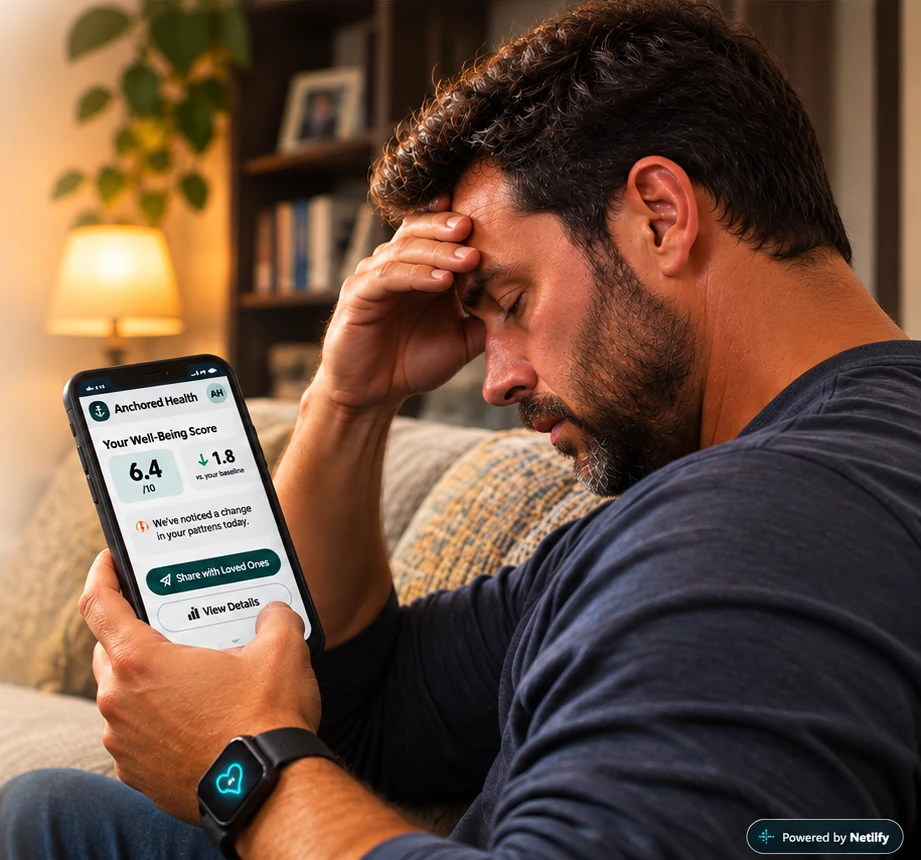
Anchored Health is a research-stage wearable mental health concept designed to combine heart-rate variability, sleep, activity, and other biometric patterns with patient feedback—exploring earlier recognition of negative changes, episode documentation, and optional support from trusted loved ones.
Initially focused on Veterans and behavioral-health care teams. Proposed detection capabilities require clinical validation; this is not a crisis monitoring service.
Appointments can be weeks or months apart. By the time someone sits down with a clinician, the hardest part may be reconstructing what happened, when it changed, and what helped.
I know something changed, but I can’t clearly show when, how often, or what it was connected to.
The proposed first version automatically examines biometric patterns, then asks the patient to confirm or clarify a possible change. This hybrid approach creates labeled episodes for future research and provider review.
Explore combined trends in heart rate, HRV, sleep, activity, and optional skin conductance against a personal baseline.
Flag patterns that warrant a check-in. Signals are nonspecific and cannot diagnose depression, anxiety, or PTSD.
Invite the patient to describe symptoms, timing, severity, and context. Preserve missed and false alerts for validation.
Build a provider-ready episode timeline and offer optional, patient-controlled heads-up messages to loved ones.
A proposed way to recognize and document changes between visits, especially when memory, stress, or limited appointment time makes it hard to summarize.
A proposed biometric and patient-reported trend view designed to support visit preparation, shared decision-making, and clinically appropriate follow-up without unnecessary noise.
A structured way to explore patient-generated context while protecting workflow, privacy, safety, and operational clarity.
Anchored Health proposes to combine several physiological and behavioral signals, evaluated against each person's own baseline and patient-reported experience. These are research candidates, not established mental-health diagnostic thresholds.
Explore changes in autonomic arousal and recovery that may accompany stress, anxiety, or PTSD symptoms.
Track sleep duration, timing, and disruption over multiple days alongside changes in mood and functioning.
Examine movement trends and, where supported, skin conductance for additional context.
Physical illness, exercise, medications, caffeine, and sensor error can affect these signals. Clinical studies must establish whether combinations detect meaningful changes accurately and early enough to be useful.
When a possible change is detected, the proposed system would preserve its timing, biometric context, patient confirmation, and follow-up notes. A concise longitudinal report could help a clinician review what happened between visits.
Potential onset, duration, signal changes, symptom ratings, and patient-supplied triggers or observations.
Patterns across weeks, with clear separation between measured data, patient reports, and model-generated flags.
Optional, discreet messages such as “A little extra patience or a gentle check-in may help today,” only under the patient's sharing preferences.
Future automatic notifications would require explicit opt-in, revocable consent, privacy safeguards, and evaluation for unintended harms.
We are gathering anonymous market feedback and voice-of-customer input from patients, veterans, clinicians, caregivers, and healthcare partners. The 15-question survey takes about 5–7 minutes.
Take the market needs survey →The provider experience is designed around concise summaries, configurable review points, and clinical workflow—not real-time surveillance.
It is creating false assurance, unclear responsibility, privacy concerns, or extra clinical burden. Those guardrails are part of the product design—not an afterthought.
Anchored Health must clearly route urgent needs to existing emergency and crisis pathways and should never imply 24/7 clinician monitoring.
Architecture, encryption, access control, retention, auditability, and system integration must align with the requirements of each health-system environment.
People should understand what they are sharing, who can see it, when it may be reviewed, and how it may support care.
Summaries, thresholds, review cadence, and ownership must fit the care model and avoid creating an unmanaged notification stream.
Our development plan starts with automatic biometric pattern analysis plus patient confirmation. Confirmed and missed episodes can support personalized model research before any transition to validated automation.
Collect wearable signals, prompt optional patient confirmation, document episodes, and test clinician reports and consent-based sharing.
Study personalized early-change models; measure sensitivity, specificity, false alerts, and detection lead time.
Consider automated episode recognition and opt-in communication only after clinical, safety, and privacy validation.
Collaborate with Veterans, clinicians, and health systems on feasibility, workflow, effectiveness, and regulatory planning.
We are seeking discovery partners who care about mental-health continuity, patient-generated health data, Veteran experience, safe digital health, and practical clinical workflows.